 NCU News
 Natural sciences
The Nobel Prize in Medicine: a New Perspective on Neurons


Karl Deisseroth, Peter Hegemann and Georg Nagel were awarded the Nobel Prize in Physiology or Medicine. The Nobel Assembly at the Karolinska Institutet honoured the scientists for their discovery of light-gated ion channels and their development of optogenetics. Prof. dr habil. Wiesław Nowak, Head of the NCU Department of Biophysics at the Faculty of Physics, Astronomy and Informatics, explains the research conducted by this year's Nobel laureates.
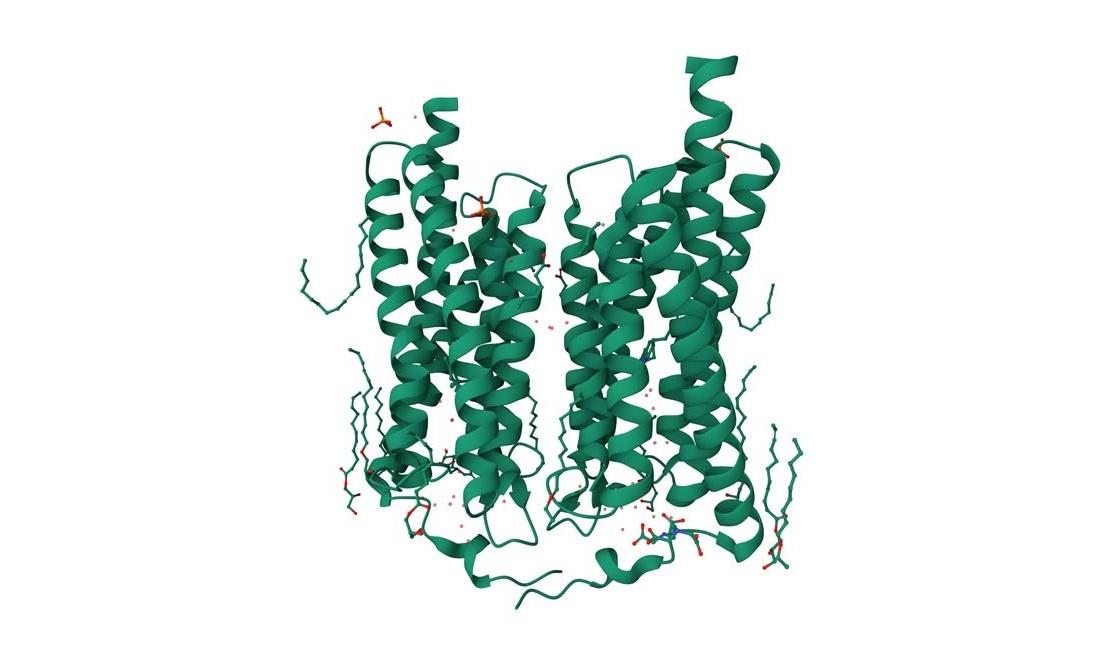
Our brains and nervous systems are made up of cells called neurons. We have approximately 100 billion of them. Neurons connect with one another through axons and dendrites (specialised cellular extensions), forming a network that enables us to live, think and perceive stimuli. The transmission of signals from one neuron to another occurs, among other mechanisms, through changes in the local electrical potential difference between the inside and outside of a neuron. These two spaces are separated by an insulating cell membrane containing proteins known as ion channels. The potential difference is maintained by ATP-powered molecular machines called sodium–potassium pumps. Ion channels contain specialised pathways that enable the selective transport of ions, primarily sodium (Na⁺) and potassium (K⁺), into and out of the neuron. During the transmission of information through an electrical impulse known as an action potential, ion channels open and close in a precisely coordinated sequence, detecting and responding to the excitation of the neuron.

Ill. Niklas Elmehed © Nobel Prize Outreach
Ion channels can be temporarily blocked using chemical agents, as is the case with some anaesthetics. They can also be permanently closed or opened by means of specific toxins. Neurobiologists have long dreamed of gaining control over the selective opening and closing of ion channels by means other than chemical intervention or the relatively crude implantation of electrodes into the brain.
The opportunity emerged in 2005 thanks to the work of Karl Deisseroth's team at Stanford University in the United States. Using molecular biology techniques, the researchers introduced into the brains of mice, with the help of lentiviruses, the gene encoding the light-sensitive ChR2 protein derived from algae. When exposed to light of an appropriately selected wavelength, this channel opens and activates the neuron.
Wiesław Nowak
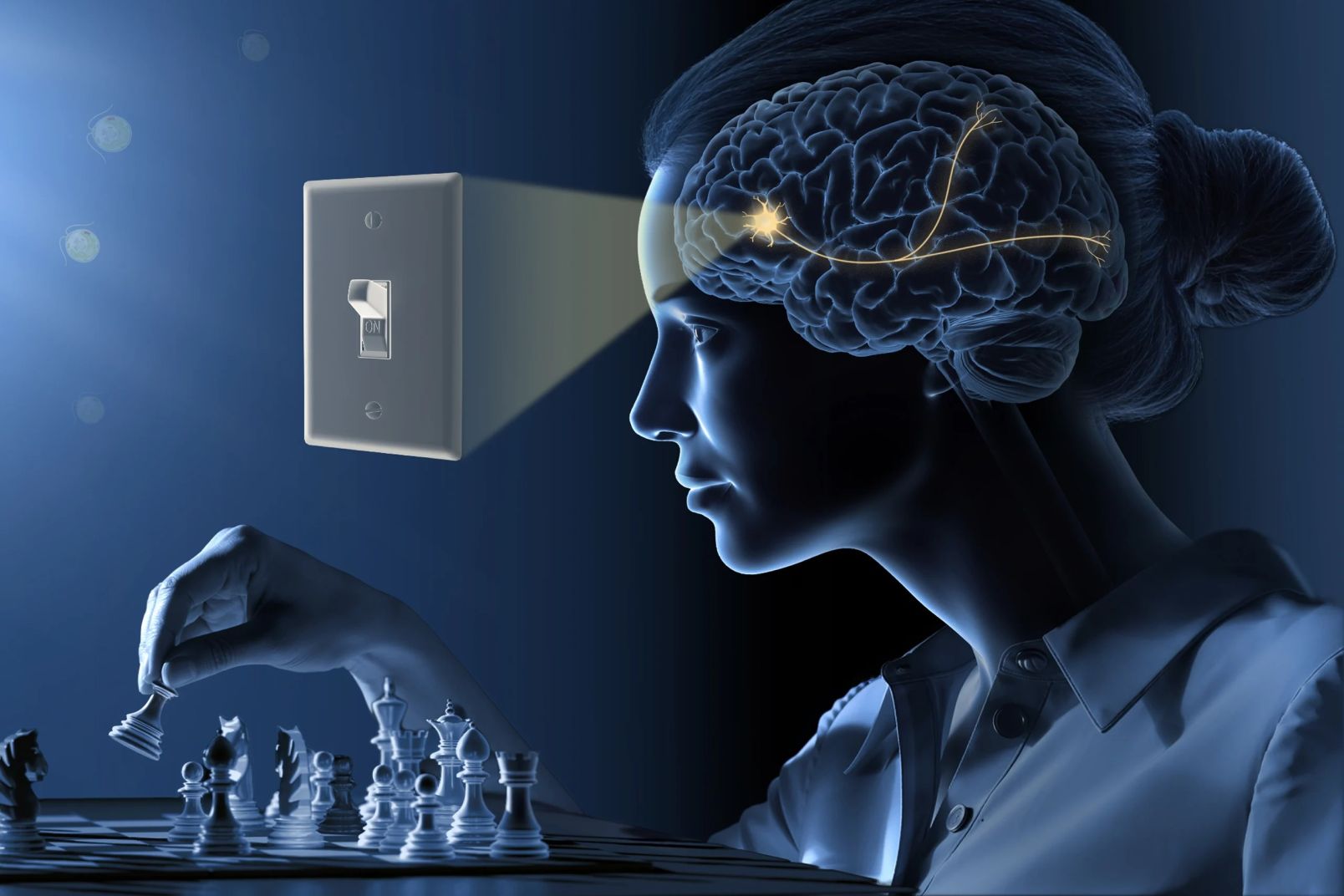
The opening and closing of artificially introduced ion channels in neurons became fully controllable, both in terms of location (the researcher can determine precisely which area of the brain the genes should be introduced into) and the duration of activation (with millisecond-level temporal resolution). The new technique, quickly named optogenetics by Deisseroth, rapidly gained popularity, to the extent that in 2010 the prestigious journal Nature Methods selected it as the “Method of the Year." Neuroscientific research gained new momentum, with an increasing number of reports demonstrating the possibility of selectively controlling the nervous systems of increasingly complex organisms using light. Since then, progress has been enormous.
Optogenetics holds great promise for medical research. Experiments are being conducted to restore vision in blind subjects, and there has been speculation about the possibility of developing an optogenetic “hearing aid." It has also been demonstrated that mice addicted to cocaine can be weaned off the drug, and there are serious efforts underway to explore its potential for treating Parkinson's disease. Transgenic mice have been developed whose skin is sensitive to light thanks to genetically modified neurons. Before moving towards translational medicine, challenging and, in some cases, ethically controversial experiments are already being conducted on non-human primates. Entire arrays of light-sensitive channel proteins responsive to different wavelengths, including infrared light, have been developed. The aim is to use longer-wavelength radiation to activate the channels, allowing deeper penetration into tissue. It is worth noting that optogenetics is not limited to ion channels. A range of other systems have been developed that enable the optical regulation of gene expression. These tools are likely to accelerate the development of molecular biology.
Ill. Mattias Karlén
When will optogenetics enter clinical practice? It is difficult to say. A number of challenges still need to be addressed, including the selection of viral vectors for delivering genes encoding light-sensitive ion channels, delivering light to the site of stimulation, ensuring the long-term stability of the system, monitoring its effects, and determining the appropriate dosing of the light pulses used for therapeutic purposes. The light delivered must not damage neural tissue, while new procedures must meet increasingly stringent safety requirements for gene therapies.
We have been conducting research on photoactive proteins at the Department of Biophysics at the NCU Institute of Physics for many years, including ChR2-type ion channels used in optogenetics. Using computational methods to model protein dynamics, we seek to understand the molecular mechanisms underlying the opening and closing of these channels. We investigate how light-induced conformational changes affect ion channels.
Our research has been inspired, among other things, by the work of this year's Nobel laureates: Karl Deisseroth, Peter Hegemann and Georg Nagel. Our work also focuses on the optical control of potassium channels, which play an important role in insulin secretion.
Georg Nagel and Peter Hegemann from the Max Planck Institute for Biophysics in Frankfurt were the first to highlight the potential of the light-switchable channelrhodopsin protein ChR2 from the alga Chlamydomonas reinhardtii in a 2003 publication in PNAS. As mentioned above, Karl Deisseroth demonstrated how the selective expression of this protein in neurons could be achieved and how precisely the activity of these neurons could be controlled using blue light.
Peter Hegemann, born in 1954, is regarded as the discoverer of photoactive opsins. He grew up in Aachen, Germany, in a medical family. He studied chemistry and earned his doctorate in biochemistry, while he made his key discovery as a professor at the University of Regensburg. He became interested in algal ion channels while working as a postdoctoral researcher in New York at Syracuse University. He is currently Professor of Experimental Biophysics at Humboldt University of Berlin, where he holds the Hertie Senior Research Chair for Neurosciences.
Georg Nagel, born in 1953, co-discovered photoactive ion channels in algae with Peter Hegemann. He studied biology and biophysics at the University of Konstanz, Germany. He received his doctorate from the University of Frankfurt in 1988. For several years, he headed an independent research group in the Department of Biophysical Chemistry at the Max Planck Institute of Biophysics in Frankfurt. Since 2004, he has been a professor at the University of Würzburg.
Karl Deisseroth, born in 1971, studied biochemical sciences at Harvard University and earned his MD-PhD in neuroscience from Stanford University in 1998. He completed his residency in psychiatry and is affiliated with Stanford University Hospital. He has made major scientific contributions not only to optogenetics but also to functional materials science, where he developed specialised hydrogels that integrate with biological tissue (CLARITY). More recently, his team demonstrated that cardiomyocytes—appropriately modified heart muscle cells—can also be controlled using light.