 NCU News
 Exact sciences
A fast radio burst with the exact address


An international team of astronomers, including scientists from the NCU Institute of Astronomy has precisely located the multiple source of fast radio bursts. The radio telescope at the Astronomical Observatory in Piwnice played an important role in the research.
Fast Radio Bursts (FRBs) are short but intense pulses of radio waves originating from cosmological distances. Although thousands of FRBs have already been detected, their physical origin remains a mystery. Most of them appear only once, but a small fraction repeats, allowing for more detailed study of this phenomenon.
International observations
The observations and research were conducted by an international team led by astronomers from the Netherlands. They used the European VLBI Network (EVN) – a system of radio telescopes scattered across Europe and beyond, operating as a single Earth-sized instrument. Signals from these antennas are combined (a process called correlation) at the Joint Institute for VLBI ERIC (JIVE) in the Netherlands, enabling researchers to determine the positions of cosmic radio sources with remarkable precision, comparable to seeing a handbag on the Eiffel Tower from New York.
The researchers managed to precisely locate the multiple source of FRBs – they confirmed that the signal comes from inside a source of constant radio emission. They described their discovery in an article entitled A Milliarcsecond Localisation Associates FRB 20190417A with a Compact Persistent Radio Source and an Extreme Magnetoionic Environment, which was published in "The Astrophysical Journal Letters".
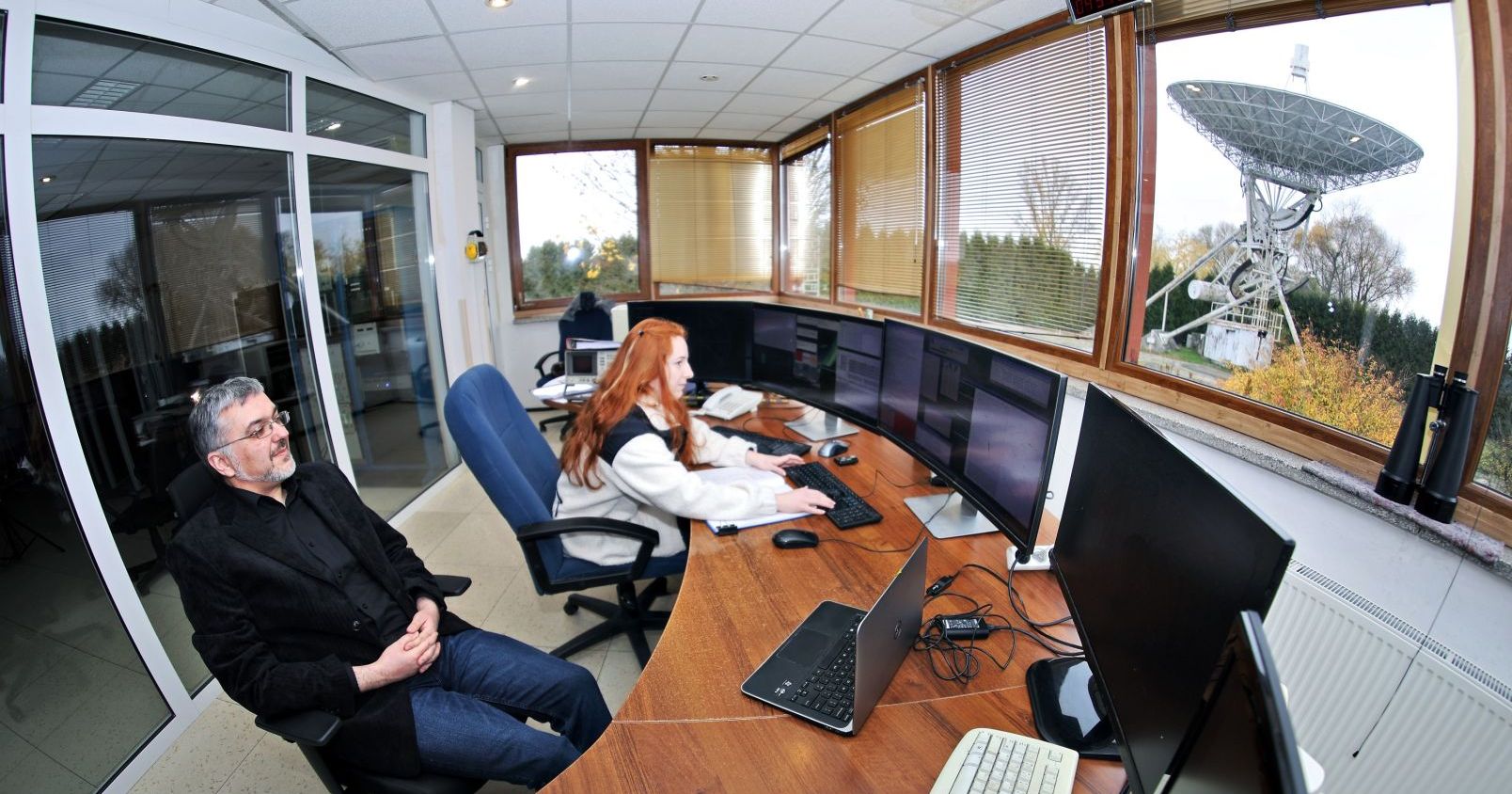
The researchers from the NCU Institute of Astronomy at the Faculty of Physics, Astronomy and Computer Science played an important role in the project. They used the radio telescope at the Piwnice Astronomical Observatory, which is part of the European VLBI Network (EVN).

The Toruń radio telescope is an important part of European research into the FRB phenomenon. We use it to make unique observations, both in interferometric mode and with a single antenna - explains dr Marcin Gawroński from the NCU Institute of Astronomy. - We have managed to estimate the basic physical parameters of the radio emission source associated with FRB 20190417A, which is an essential step towards understanding its origin.
A local environment with extreme properties
The FRB 20190417A is a repeating FRB source discovered in 2019 by the CHIME/FRB Collaboration. Its unusual properties suggest that it is located in a dense and strongly magnetic environment. Previous observations indicated a source of radio emission near the FRB position, but until now there had been no direct determination of the object's coordinates with sufficient precision.
- Thanks to the EVN, we were able to locate the FRB 20190417A with millisecond angular arc precision and directly compare its position with that of a fixed radio source - says Alexandra Moroianu, lead author of the study and PhD student at the Anton Pannekoek Institute for Astronomy and JIVE. - We discovered that the bursts and this source coincide spatially, confirming their physical connection.
The EVN observations show that the steady radio source is compact, with a size limited to less than 80 light-years, comparable to a supernova remnant. Although FRBs last only milliseconds, sources of steady radio emission can be active for years. Despite the large number of FRBs discovered, only a small fraction have been linked to such objects.
The FRB 20190417A becomes the fourth well-documented system in which the object generating the FRB is directly linked to a source of continuous radio emission - astronomers report.
– With this new result, a pattern is beginning to emerge - adds Moroianu. - These particular FRB sources, which emit multiplebursts, seem to exist in extreme environments, areas of ionised plasma located in a strong magnetic field. They often occur in dwarf galaxies with a poor chemical composition that are actively forming stars.
One of the leading hypotheses concerning repeating FRBs links them to magnetars – neutron stars with super-strong magnetic fields, formed in supernova explosions. In these models, constant radio emission can be generated by a nebula that is the remnant of a supernova explosion, powered by a compact, young object with extreme properties – the remnant of a massive star. Thanks to the observations of an international team, it is known that if these constant radio sources are powered by magnetars, they must be very young on an astronomical scale – less than a thousand years old.
RT 4 on the track of bursts
New observations made regularly by the EVN, including the Toruń antenna, enable the precise determination of the positions of subsequent FRB sources. The location of the FRB 20190417A and the connection of this object with a source of constant radio emission demonstrate the importance of such projects, which are essential for understanding the origin of fast radio bursts and the physical processes behind this phenomenon - adds dr Gawroński.
Astronomers hope that further observations and detection of other FRBs using the EVN will help them determine whether the sources of continuous radio emission are a short-lived phase common to many FRBs or a defining feature of a separate set of these phenomena.