 NCU News
 Exact sciences
The secrets of the birth of massive stars


An international research team of astrophysicists from Italy, the Netherlands, and South Africa, led by Dr. Anna Bartkiewicz, professor at the Institute of Astronomy of the Nicolaus Copernicus University in Toruń, has made groundbreaking observations of massive young stars in the Milky Way.
Using the Very Large Array (VLA) radio telescope network in the US, the scientists looked deep into dense dust clouds where objects with masses exceeding eight times that of the Sun are forming, which will end their lives as supernovae. Their birth is still difficult to study because it occurs inside very dense gas and dust cocoons that are impenetrable to visible light, typically at distances greater than 1,000 light-years.
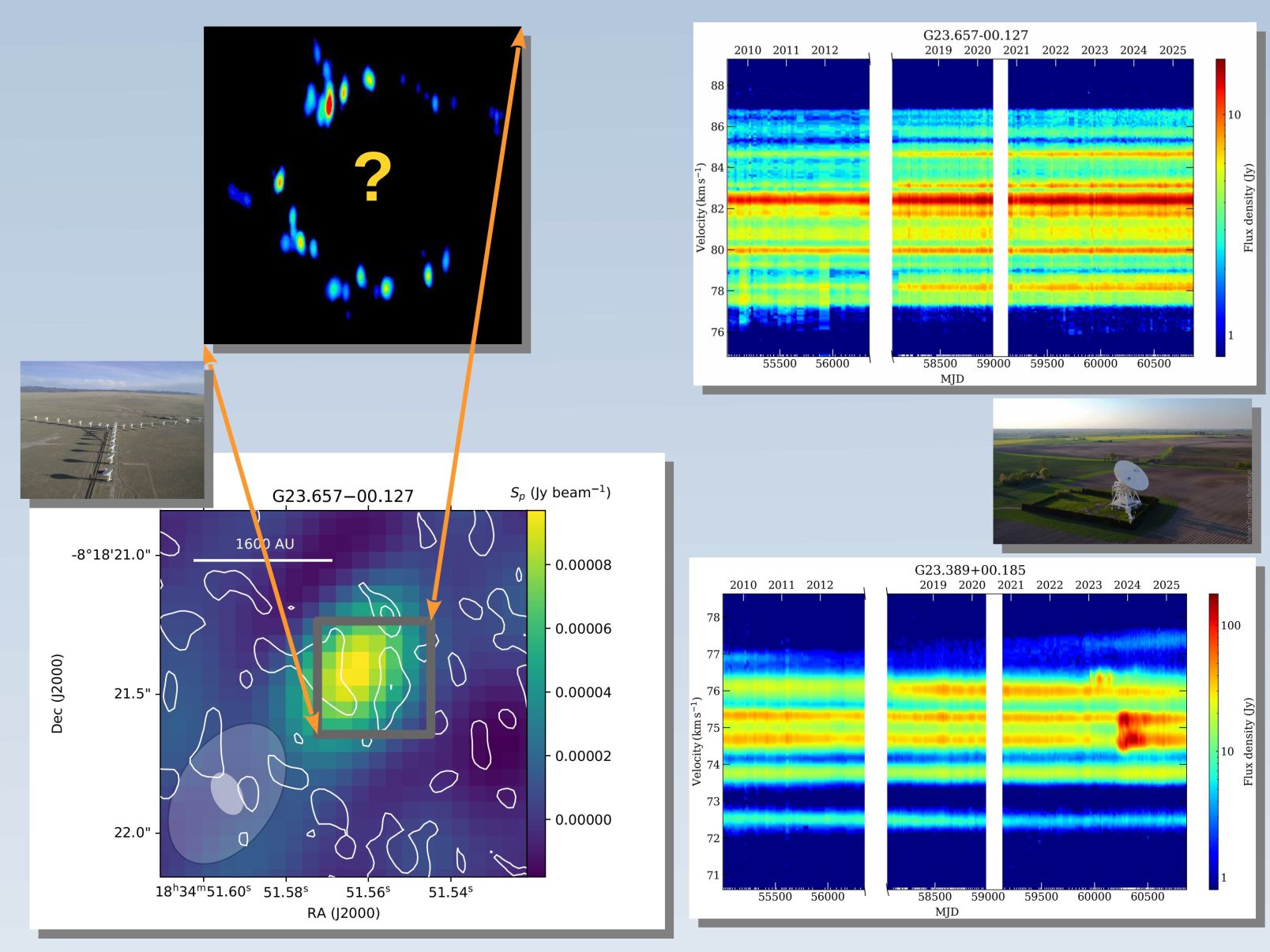
Methyl alcohol molecules emitting maser radiation at a wavelength of 4.5 cm have proven to be a key tool for astronomers. These natural "cosmic lasers" amplify microwaves and are a common marker for massive protostars, revealing the physical properties and structure of the gas in their immediate surroundings. Two decades ago, the team discovered the characteristic arrangement of maser clouds into ring structures. The objects came from a unique sample of sources discovered and currently monitored using the 32-meter NCU radio telescope. It was only after the VLA instrument was upgraded, thanks to its very high sensitivity, that researchers were able to obtain the first images of continuous radiation emissions from the center of the rings for the four objects studied.
Until now, we assumed that maser rings surround the youngest protostars, even before the phase of strong radiation from the nascent star on its surroundings. The latest data suggest the opposite: systems with maser rings may be more evolutionarily advanced - explains Prof. Anna Bartkiewicz. - Over the lifetime of a massive protostar, methanol maser clouds form a ring pattern, as the conditions favorable for their formation appear in the outer parts of the disk, from which the central star no longer draws matter. Our research shows that the most regular ring, G23.657−00.127 (named after its galactic coordinates), is over 50,000 years old and is the oldest in the sample studied. It is also one of the few objects with methanol maser emission characteristically located, the ring is perpendicular to the line of sight.
Ashwin Varma, PhD student at the Doctoral School of Exact and Natural Sciences at NCU, adds:
These objects are regularly observed by the Toruń radio telescope and show no significant variability, confirming that mass accretion by the central star has ceased. In slightly younger objects, brightening occurs, but only in some clouds, as was the case at the end of 2024 in the protostar G23.389+00.185. This is not the episodic accretion observed in other objects monitored by the 32m radio telescope, as reported in "Nature Astronomy", but a different mechanism that has yet to be thoroughly investigated.
These results, published in the prestigious journal "The Astrophysical Journal", represent a significant step in mapping the earliest stages of the life of the most powerful stars in our Galaxy. They are part of a project carried out under the Opus grant of the National Science Centre "Cosmic masers as a tool for identifying accretion explosions of massive protostars".