 NCU News
 Exact sciences
Molecules trapped in a one-dimensional crystal of light


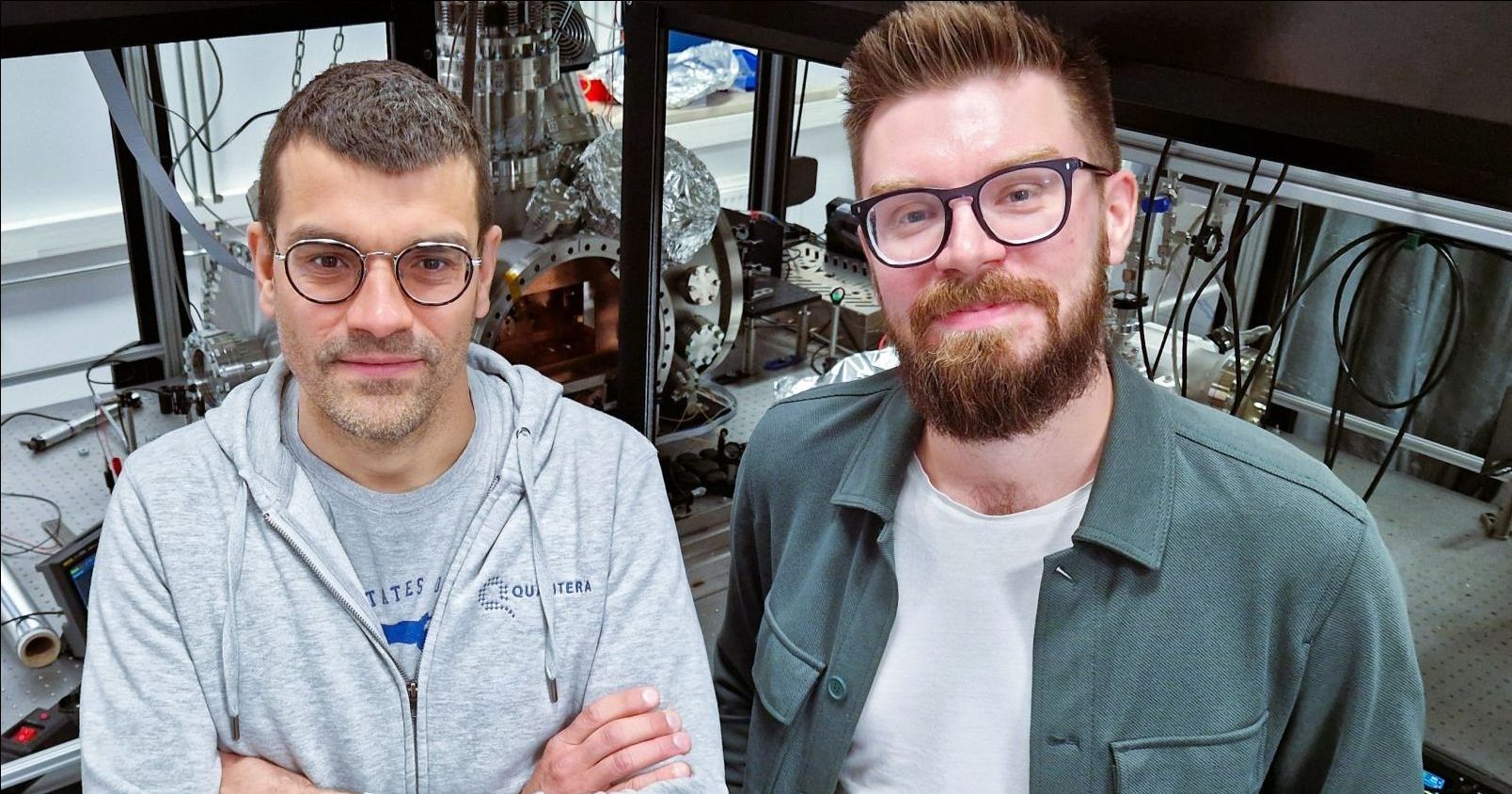
An international research team, including two researchers from the Faculty of Physics, Astronomy and Computer Science prof. dr habil. Piotr Wcisło and dr Hubert Jóźwiak, has developed a method of 'freezing' molecules in a one-dimensional laser beam, allowing them to be studied with unprecedented precision. This is a step that paves the way for completely new tests in quantum physics.
However, a serious challenge for ultra-precise testing of quantum theory for real physical systems (such as atoms or molecules) is their motion and interaction with the environment, which blur the measurement. The non-zero velocity of the molecules under study causes the energy of the emitted photon to differ significantly from the true value (Doppler effect). In fact, at room temperature, the chaotic thermal motion of molecules completely ruins measurement precision.
An international research team, including two employees of the NCU Institute of Physics: prof. dr hbil. Piotr Wcisło and dr Hubert Jóźwiak, presented a completely new approach to solving this problem. The scientists created an extremely powerful laser beam with a periodic standing wave structure (a kind of one-dimensional light crystal). The movement of thermal molecules entering the measurement area was automatically limited by the optical forces of the laser beam. The molecules were effectively 'frozen' in the direction of observation, which radically increased the measurement capabilities.
The results of the research pave the way for a completely new type of measurement technology. The researchers presented it in their paper Letokhov-Chebotayev Intracavity Trapping Spectroscopy of H2, where they described the operation of the new method for the case of a hydrogen molecule, although it is universal and can be applied to various atomic and molecular systems. The achievement was published in the prestigious journal Physical Review Letters on 25 November 2025, and the paper was highlighted by the editors as Featured in Physics and Editors' Suggestion.