 NCU News
 Exact sciences
The key to secure satellite communications


Laser communication enabling data encryption between satellites and Earth could form the basis of future satellite-based systems. Researchers at the Nicolaus Copernicus University have investigated the extent to which turbulence, wind and measurement noise affect the effectiveness of space-based cryptographic key distribution.
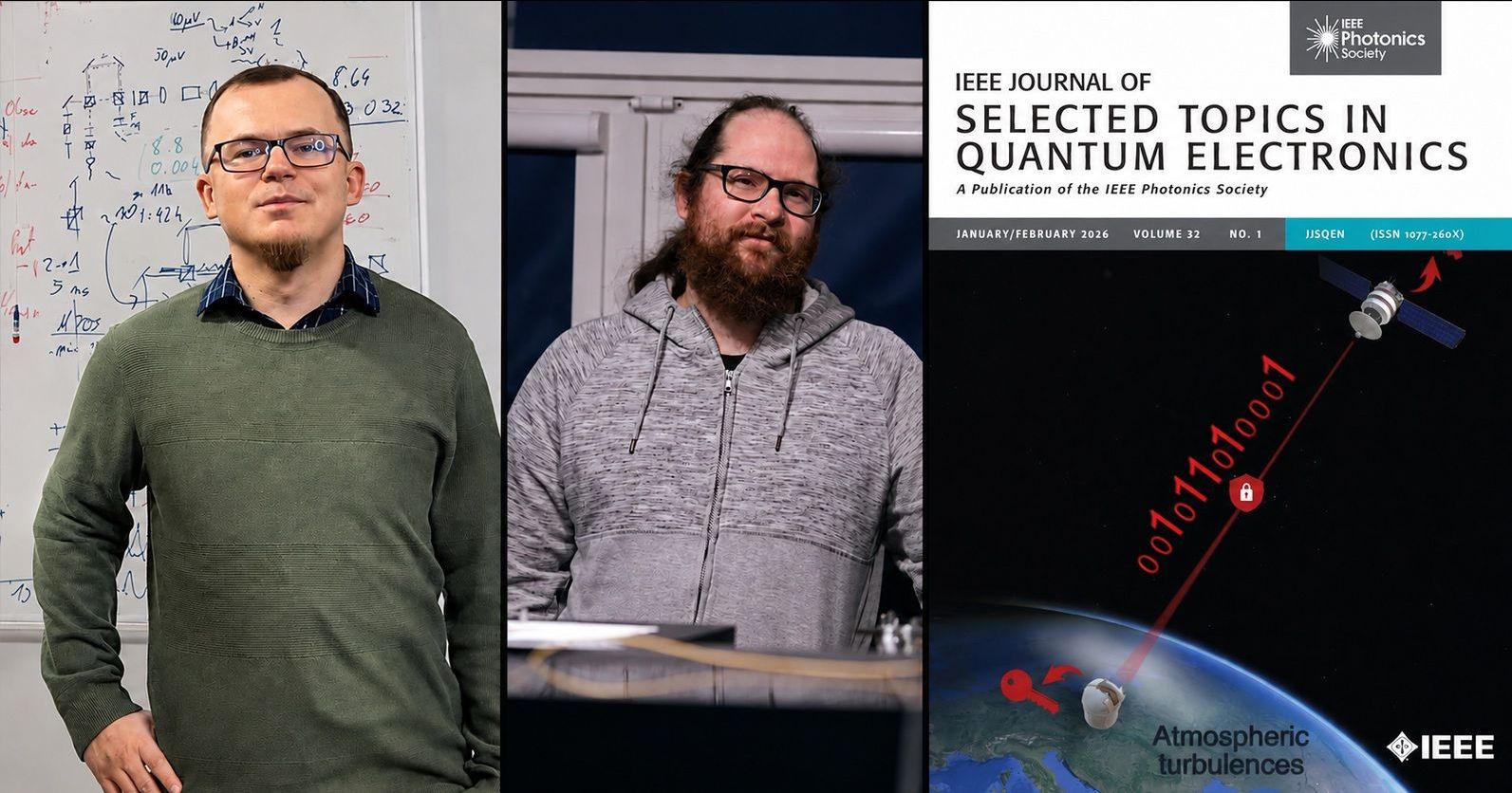
Light instead of radio waves, satellites instead of cables, and eavesdropping-resistant encryption – it sounds like the technology of the future, but researchers from the Department of Atomic, Molecular and Optical Physics at the Institute of Physics, within the NCU Faculty of Physics, Astronomy and Informatics are currently working on precisely such solutions. Their analyses show that the Earth's atmosphere itself may be the greatest adversary of modern systems. They shared the results of their latest research in an article Modeling Optical Key Distribution over a Satellite-to-Ground Link Under Weak Atmospheric Turbulence. The editorial team of the "IEEE Journal of Selected Topics in Quantum Electronics" chose this topic for the cover of the issue, thereby confirming the importance of research into secure communication. The authors of the paper (in order) are researchers from our university's Institute of Physics: dr Artur Czerwiński and dr Mikołaj Lasota, and researchers from the University of Warsaw: dr Marcin Jarzyna, mgr Mateusz Kucharczyk dr Michał Jachura, and prof. dr habil. Konrad Banaszek.
Optical key distribution
Our work concerns the Optical Key Distribution (OKD) protocol, a solution developed and patented by researchers from the Nicolaus Copernicus University and the University of Warsaw. On the NCU side, the patent's authors are dr habil. Piotr Kolenderski, NCU Prof. and Dr Mikołaj Lasota," explains dr Artur Czerwiński. “The OKD method enables the establishment of a secure cryptographic key between two parties through the modulation of light intensity, i.e. the transmission of pulses of varying power (weak and strong pulses encoding the digits 0 and 1 respectively in the binary system). Possession of a shared secret key then allows for the exchange of encrypted messages without the risk of them being read by a third party.
In the published article, the researchers expand on this concept. Among other things, they analyse the potential applications of the OKD protocol in satellite optical communications, taking into account the impact of atmospheric turbulence.
Light-based communication
Satellite communication is today mainly associated with radio waves, but systems using laser light are becoming increasingly important. In such solutions, data is transmitted via highly precise laser beams between the satellite and the ground station. This technology, known as free-space optical communication, enables high data rates whilst offering a high level of transmission security.
The authors of the study focused on one of the most significant challenges associated with this type of communication: establishing a secure cryptographic key between a satellite in low Earth orbit and a receiver on Earth. This is important because a cryptographic key can be likened to a digital access code that enables the encryption of information and protects communications from eavesdropping.
In theory, transmitting data using light seems highly efficient, but in practice the signal must pass through the Earth's atmosphere. It is the atmosphere that proves to be one of the greatest challenges: temperature variations, air mass movements and wind cause turbulence that disrupts the propagation of the light beam. The main atmospheric effects include fluctuations in light intensity, slight but chaotic deviations in the direction of transmission, and a loss of the beam's spatial uniformity – explains dr Czerwiński.
The researchers have developed a model that takes into account the key factors affecting connection quality. The analysis took into account light absorption and scattering in the atmosphere, losses resulting from beam geometry, transmitter and receiver alignment errors, and random fluctuations in signal strength. This made it possible to realistically estimate how much secure data can be transmitted under various weather and technical conditions.
Particular attention was paid to the impact of wind-induced atmospheric turbulence.
– We compared situations where atmospheric conditions were relatively stable with cases involving more severe atmospheric disturbances. The results showed that an increase in turbulence can significantly reduce the efficiency of secure transmission. The more unstable the atmosphere, the more difficult it is to maintain a high-quality optical link – explains dr Czerwiński.
Secure satellite communications thanks to Polish technology
In addition to changing weather conditions, the study took into account the presence of a third party – an eavesdropper – who, using their own telescope, could intercept part of the optical signal. It turns out that the OKD protocol ensures the generation of a secure cryptographic key even in a situation where the eavesdropper has an advantage resulting, for example, from better atmospheric conditions or a larger receiving telescope.
We have taken into account various configurations of parameters describing the role of the eavesdropper, as well as different scenarios relating to measurement noise and error correction schemes on the receiver's side. Of course, each of these parameters can significantly affect the length of the cryptographic key, but even assuming an advantage on the eavesdropper's side, secure communication is still possible – says dr Czerwiński.
An interesting conclusion can be drawn from a comparison of the results obtained using the OKD protocol with those obtained using quantum key distribution (QKD). The study by the Nicolaus Copernicus University researchers showed that the OKD method allows for the generation of a cryptographic key up to ten times longer than that produced by QKD, even under very adverse conditions.
– Our research has shown that quantum technologies are not the only avenue for development in the field of cybersecurity. OKD is a new and promising method for the secure exchange of information, and our study provides key insights into the performance of this protocol in satellite environments, explains dr Czerwiński. – Understanding the impact of turbulence, noise and transmission errors can help in building more reliable and secure next-generation communication networks. Technologies of this type may play a significant role in the future in global encrypted communication systems linking satellites, data centres and terrestrial telecommunications networks.